Rebounding for beginners: how to start
What rebounding is, what you need, and a sensible first fortnight on a mini trampoline.
By the team at Trampolines Ireland. Checked 9 October 2026.
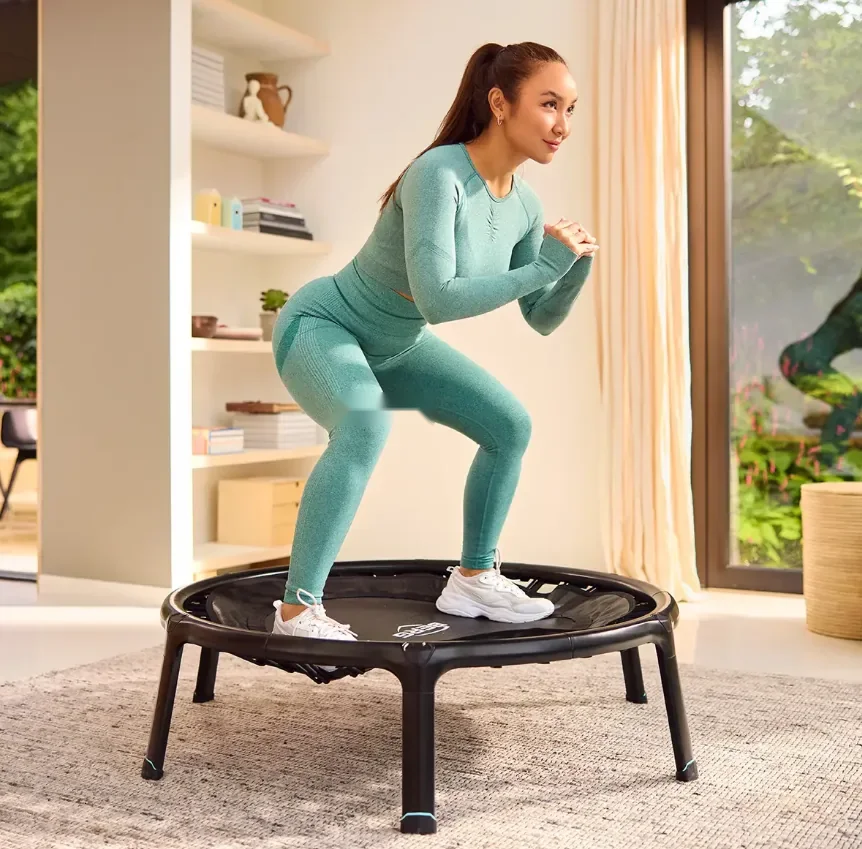
What rebounding is
Rebounding is exercise on a mini trampoline, usually called a rebounder. It is not gymnastics. Most of it is bouncing, marching and jogging on the spot, with your feet rising a few centimetres or not leaving the mat at all.
It is aerobic exercise you can do indoors in a small space. In one small ACE-sponsored study, 24 active young adults doing a 19-minute choreographed routine reached about 79% of their maximum heart rate. That was a set workout done by fit students. A beginner's gentle bounce will be easier than that, which is the right place to begin.
What you need
- A rebounder made for adults. Check the maximum user weight. The BERG Fitness Trampoline 110 we sell is rated to 120 kg and is for users over 14, one at a time.
- Room around it. BERG asks for one metre clear on every side and 2.4 metres overhead, and never under a light fitting or ceiling fan. That overhead figure is about the height of a standard ceiling, so measure yours.
- A level floor indoors where the feet will not slide.
- Bare feet or grip socks. No shoes, and nothing in your pockets.
You do not need an app, a class or special clothes. We do not offer classes or videos, and nothing in this guide depends on them.
Do you need a handle?
A stability bar gives you something to rest a hand on while you find your balance. It suits people who are new to exercise, returning after a break, or less steady on their feet. It is for light support only: stand upright and do not lean on it or pull against it. We sell the same rebounder without the bar for €369 and with the bar for €449. The shop shows the current price.
Check first if any of this applies
Speak to your GP or a chartered physiotherapist before you start if you are pregnant or had a baby in the last three months, have osteoporosis or a previous spinal fracture, a heart condition, pelvic floor symptoms, a balance problem, a recent operation or joint injury, or have not exercised for some time.
The bone point matters. A 2023 case series described seven people, average age 63, with spinal compression fractures within weeks of taking up mini-trampoline exercise. If your bone density is low, get advice first and start very gently.
Your first session
- Warm up on the floor for two or three minutes: walk on the spot, circle your ankles, roll your shoulders.
- Step on to the middle of the mat, not the frame edge. Stand still and let it settle.
- Start the health bounce, which is only the common name for a bounce where your feet stay on the mat. Press down, let the mat lift you, and keep your knees soft.
- After a minute or two, try a slow march. Then go back to the bounce.
- Stop after about five minutes. Step down. Do not jump off.
Look straight ahead, not at your feet. Each move is described step by step on our rebounder exercises page.
A sensible first fortnight
Six short sessions with a rest day between each. Add minutes before you add height or speed. If a session feels like too much, repeat the one before.
| Day | Time | What to do |
|---|---|---|
| 1 | 5 min | Health bounce, with a minute of heel raises and weight shifts in the middle. |
| 3 | 5 min | Health bounce and march, a minute of each in turn. |
| 5 | 6 min | As day 3. Finish with a single-leg balance hold on each leg. |
| 8 | 8 min | Add the side-to-side step between the bounce and the march. |
| 10 | 8 min | Add one minute of gentle jog. Drop back to a march if you cannot talk easily. |
| 12 | 10 min | The gentle workout from our three 10-minute workouts. |
Some people are ready for ten minutes sooner and some take a month. Both are fine.
How hard should it feel?
Use the talk test. At moderate intensity you are warm and breathing harder, and you can talk but not sing. If you can only get out a few words, ease off.
Ireland's guidelines ask adults for at least 150 minutes of moderate activity a week, plus muscle-strengthening on two or more days. A rebounder is one convenient way to add to those minutes at home. It will not cover the strength part, so keep up whatever else you do.
When to stop
- You feel faint, dizzy, breathless or in pain. If dizziness does not pass, contact your GP.
- You leak urine or feel heaviness in your pelvis. Go back to a bounce with your feet on the mat, or pause, and ask your GP about a pelvic health physiotherapist.
- You are tired enough that your feet are landing near the edge.
Mistakes beginners make
- Bouncing high. Height adds risk long before it adds anything useful. Keep it low.
- Looking down. It tips your weight forward.
- Hunching over the handle. Stand tall with a light hand on the bar.
- Doing too much in week one. Five minutes is a real session when the surface is new to you.
For what rebounding has and has not been shown to do, read what the evidence shows. If you have a question about the rebounder itself, ring us on 01 960 1641.
This is general information, not medical advice. If you are pregnant or recently gave birth, have osteoporosis or a previous spinal fracture, a heart condition, pelvic floor symptoms, a balance disorder, a recent operation or injury, or have not exercised in a long time, talk to your GP or a chartered physiotherapist before you start.