Rebounding vs running: what the research says
Where the famous "NASA study" claims come from, what the paper measured, and how the two compare in practice.
By the team at Trampolines Ireland. Checked 9 October 2026.
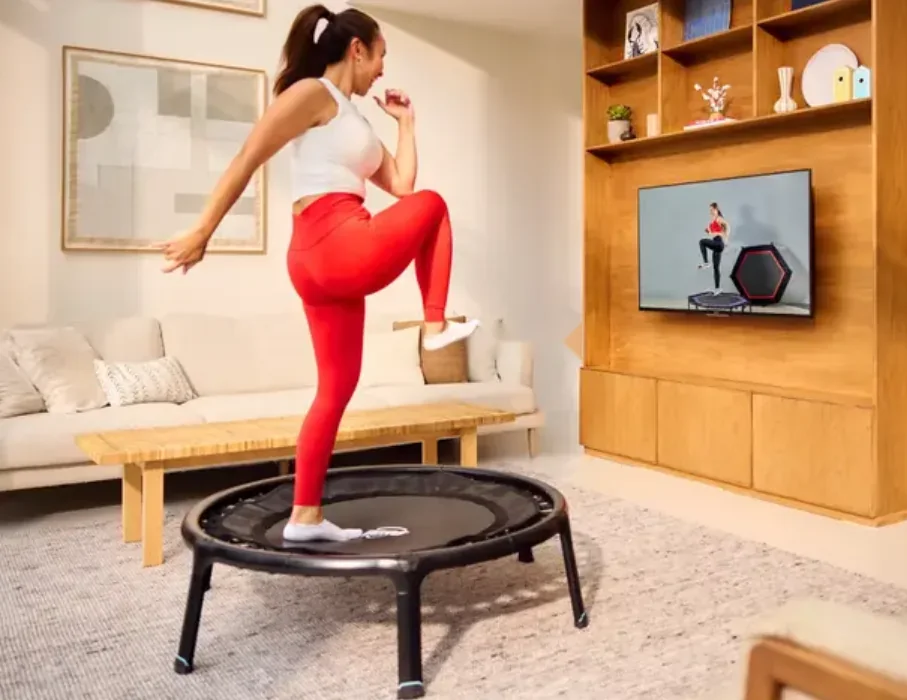
Search for rebounding and within a minute you will read that it is "68% more effective than jogging", or that ten minutes on a mini trampoline equals thirty minutes of running. NASA's name is usually attached. Both lines trace back to one paper from 1980, and neither is what the paper says.
What the 1980 paper measured
The paper is by Bhattacharya and colleagues, in the Journal of Applied Physiology. They were looking for exercise that might counter deconditioning in weightlessness, which is where NASA comes in.
Eight young men, aged 19 to 26, took part. Each carried a 5 kg instrument pack. They walked and ran on a treadmill at four speeds, from 4.8 to 11.3 km/h, and jumped on a trampoline at four heights, from 18 cm to 100 cm, for five minutes at each level. Accelerometers were fixed at the ankle, the lower back and the forehead. Oxygen use and heart rate were recorded throughout.
The findings were about how force travels through the body:
- When running, the peak acceleration was always highest at the ankle and much lower at the back and head.
- When jumping on the trampoline, the acceleration was spread more evenly across all three points.
- The relationship between heart rate and oxygen use was essentially the same for both activities.
Where "68%" comes from
The authors compared acceleration at the back, per kilogram, for running and jumping at the same oxygen use. The two curves differed, and the paper notes that the greatest difference was about 68%. That is the whole origin of the number. It is the largest single gap in one acceleration measurement, not a measure of efficiency.
The paper did not measure:
- fitness gained over weeks of training,
- fat loss or weight loss,
- any calorie advantage for one activity over the other,
- lymph, bone density or anything else it is now quoted for.
The "10 minutes equals 30 minutes" ratio does not appear anywhere in the paper as we read it, and nothing in it supports swapping one activity for the other by time. The trampoline used also allowed jumps of up to a metre. That is a long way from a low bounce on a home rebounder.
How hard is rebounding, compared with running?
It can be real cardio. In a small ACE-sponsored study of 24 active college students, a 19-minute choreographed mini-trampoline routine averaged about 79% of maximum heart rate, yet the participants rated it as only light to moderate effort. The article likens the energy used in that routine to running at about 6 mph, which is roughly 9.7 km/h.
The caveats matter. These were fit young people following one branded routine in a single session, the study had no control group, and it was published in ACE's own magazine, not a peer-reviewed journal. It tells us nothing about a gentle bounce.
One comparison points the other way. A 2001 conference abstract by Volker and colleagues had 21 adults aged 20 to 30 step at the same rate on a mini trampoline and on a treadmill. Oxygen use was consistently higher on the treadmill. We have only seen the abstract, which gives no figures.
No study we found shows rebounding beating running minute for minute.
Impact: softer at the feet, with caveats
An elastic mat gives a softer landing than a hard floor. One lab study of 34 men, by Ozdalyan and colleagues in 2022, found lower landing forces and loading rates when dropping onto a mini trampoline than onto solid ground. Those were drop jumps, not a rebounding workout, and we have read only the abstract.
The 1980 paper agrees for the ankle: peak acceleration there reached 12 G when running and 7 G on the trampoline. But at the back and the head it was higher on the trampoline, not lower. So "lower impact" holds for the feet and ankles in that data, and not for the spine.
That fits a 2023 case series by Park and colleagues: seven people, average age about 63, who had compression fractures in the mid-back within weeks of starting regular mini-trampoline exercise. Only four of the seven had confirmed osteoporosis. If you have osteoporosis or have had a spinal fracture, get advice before you start.
We found no study that measured knee or hip loads during ordinary home rebounding against running, and none showing fewer injuries.
The two side by side
| What | Running | Rebounding |
|---|---|---|
| Space | A road, path or pitch, or a treadmill | A 110 cm frame, 1 m clear on every side and 2.4 m overhead |
| Weather | Whatever the day brings | None. It is used indoors |
| Impact | Highest at the ankle in the 1980 data | Lower at the ankle, higher at the back and head in the same data |
| Skill | Familiar from the first step | You balance on a moving surface, so start low and slow |
| What the research supports | Much more widely studied. We have not reviewed that research here | A handful of small studies: real cardio in a structured routine, softer landings underfoot, nothing showing it beats running |
Who might prefer which
If you enjoy running and it suits your body, nothing here is a reason to stop. It needs no equipment and it gets you outdoors.
A rebounder may suit you better if:
- dark evenings and wet weather are what keep you from exercising,
- you want something you can do in short blocks, such as a 10-minute workout,
- you find a softer landing more comfortable underfoot.
Plenty of people do both. Ireland's guidelines ask adults for at least 150 minutes of moderate activity a week, or 75 minutes of vigorous activity. Running and rebounding can both add to that total, and a rebounder is one convenient way to add minutes at home.
For the rest of the evidence, read what rebounding does and what nobody has shown. To see the equipment itself, compare the two models.
This is general information, not medical advice. If you are pregnant or recently gave birth, have osteoporosis or a previous spinal fracture, a heart condition, pelvic floor symptoms, a balance disorder, a recent operation or injury, or have not exercised in a long time, talk to your GP or a chartered physiotherapist before you start.