Rebounding and weight loss: an honest look
How many calories the studies measured, what they did not test, and how to use a rebounder as part of a plan.
By the team at Trampolines Ireland. Checked 9 October 2026.
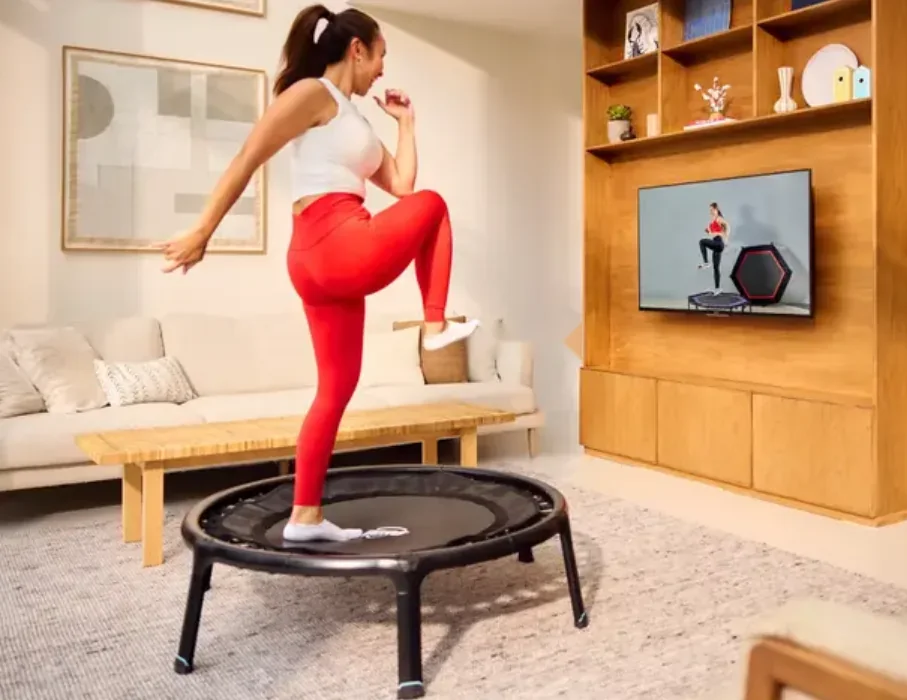
The short answer: rebounding is cardio, and cardio can contribute to a healthy weight alongside what you eat. Nobody has run a controlled trial showing that a rebounder causes weight loss, and we will not give you a number of kilos or a calorie count for your own sessions. What we can do is tell you what the studies measured.
What the studies measured
| Study | Who and what | Result |
|---|---|---|
| ACE, 2016 | 24 active college students, one 19-minute choreographed routine | About 12.4 kcal a minute for the men and 9.4 for the women during the workout portion |
| Cugusi, 2017 | 18 sedentary overweight women, one 46-minute class with an instructor | About 7 kcal a minute, roughly 300 kcal for the class, at 72% of maximum heart rate |
| Cugusi, 2018 | 18 overweight women, 12 weeks of supervised rebounding | Better fitness and blood pressure, and reported improvements in fat mass, lean mass and measurements |
The caveats, study by study
- ACE. The participants were young and fit, they followed one branded routine in a single session, and there was no control group. ACE paid for the study and published it in its own magazine, not a peer-reviewed journal. It says nothing about the energy a beginner uses in a gentle bounce.
- Cugusi 2017. Energy use was estimated by a wearable armband, not measured by analysing breath. It was one session, with no other activity to compare it against.
- Cugusi 2018. There was no control group that we could see, so the changes cannot be pinned on the rebounder as opposed to exercising regularly under supervision. The abstract we read gives no figures for fat mass, and it does not report a weight-loss amount.
These figures describe those people in those sessions. They are not a forecast for you. Your own energy use depends on your size, your fitness and how hard you work.
What has not been tested
- We found no randomised controlled trial of rebounding for weight loss.
- We found nothing showing that rebounding burns more than running. One 2001 abstract found that, step for step, jogging on a mini trampoline used less oxygen than jogging on a treadmill.
- Nothing supports the idea that it targets fat in any particular part of the body.
The honest reading is that rebounding sits alongside other moderate cardio. In the 2017 study the class averaged about 5 METs, which is moderate to vigorous. That is useful. It is not special.
How to use a rebounder as part of a plan
Weight change depends on your overall energy balance, which means diet as well as exercise. A rebounder does not change that. What exercise adds is on show in the 12-week study above: better fitness and lower blood pressure. So the question to ask of any exercise is whether you will keep doing it.
That is the real case for a rebounder. It is in the house, it does not depend on the weather, and ten minutes is enough to count. In the ACE study people also rated the effort as lighter than their heart rate suggested, which may make it easier to come back to.
To judge your effort, use the talk test. At moderate intensity you can talk but not sing. At vigorous intensity you can manage only a few words between breaths.
A realistic week
Ireland's guidelines ask adults for 150 to 300 minutes of moderate activity a week, plus muscle-strengthening for all the major muscle groups on two or more days. A rebounder can supply some of the minutes. It does not cover the guidelines alone.
One way to lay out a week once you have built up to it:
| Day | What |
|---|---|
| Monday | 20 to 30 minutes on the rebounder at a pace where you can talk but not sing |
| Tuesday | Strength work: squats, press-ups against a worktop, carrying, or weights if you have them |
| Wednesday | A brisk 30-minute walk |
| Thursday | 20 to 30 minutes on the rebounder |
| Friday | Strength work again |
| Saturday | A longer walk, a swim or a cycle |
| Sunday | Rest, or ten easy minutes on the rebounder |
If you are starting from very little, begin with five to ten minutes of gentle bouncing, feet on or close to the mat, and add a few minutes each week. Our three 10-minute workouts and the beginner exercises give you something to follow.
Before you start
- The BERG rebounder has a maximum user weight of 120 kg, about 19 stone.
- Speak to your GP first if you have not exercised for some time or have a medical condition. The authors of the 2017 study advise a cardiovascular check-up before starting for middle-aged people at high cardiovascular risk.
- Jumping can provoke bladder leaks in some people. Keep the bounce low, and if it happens, stop and ask your GP about seeing a pelvic health physiotherapist.
- Stop if you feel faint, dizzy, unusually breathless or in pain.
If you are steadier with something to hold while you build up, look at the model with the stability bar.
This is general information, not medical advice. If you are pregnant or recently gave birth, have osteoporosis or a previous spinal fracture, a heart condition, pelvic floor symptoms, a balance disorder, a recent operation or injury, or have not exercised in a long time, talk to your GP or a chartered physiotherapist before you start.